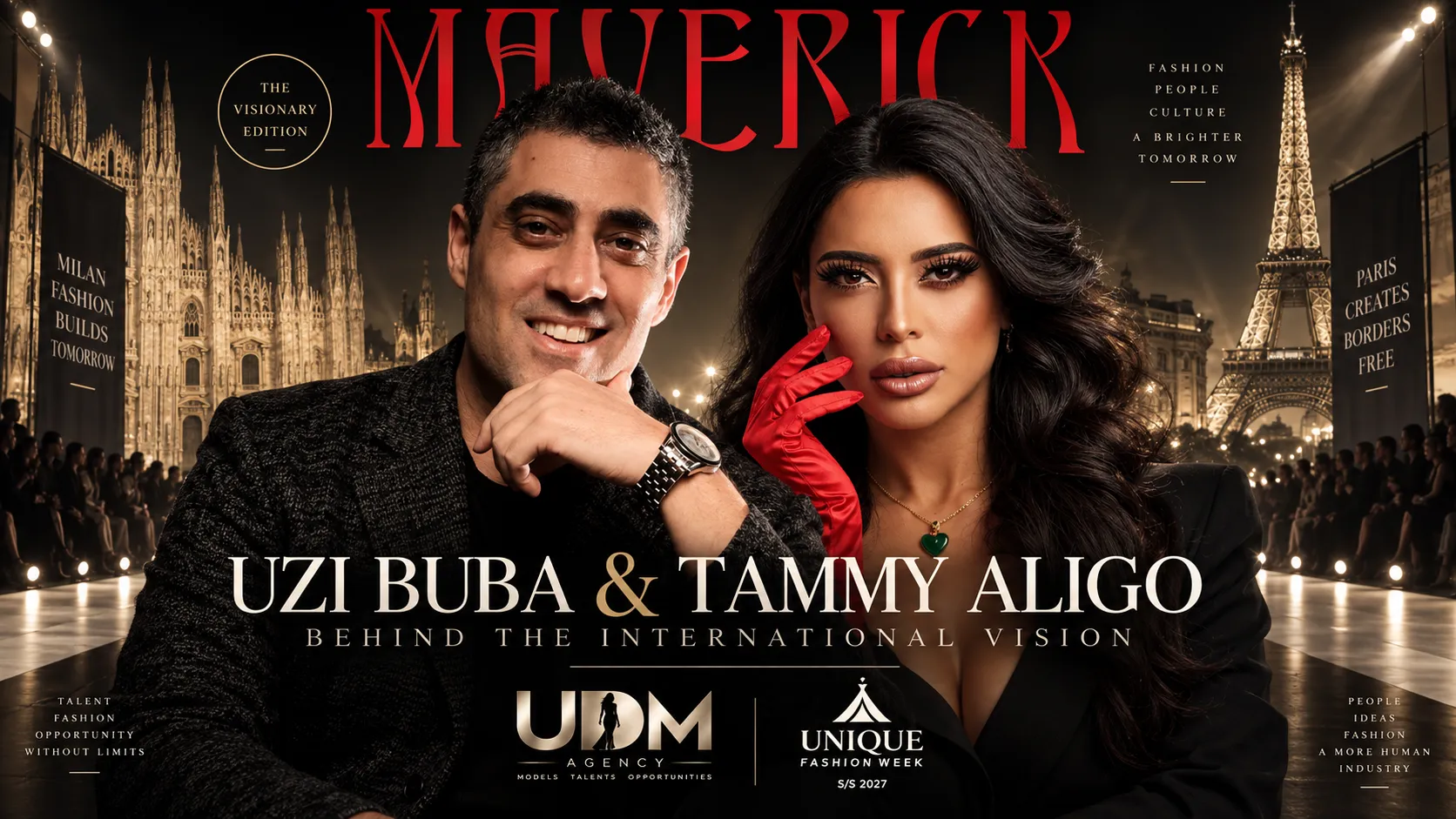
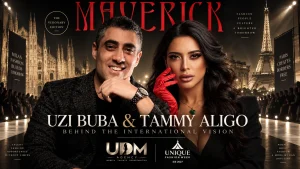
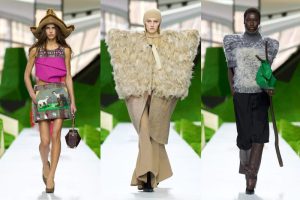
Uzi Buba brings years of experience in fashion and in working with companies in Israel and abroad, backed by a business and marketing perspective that gives him a strategic edge. Tammy Aligo grew up in Ashdod in a Georgian Jewish home, danced with the national ballet and was discovered by chance on a street in Milan. Now, through the partnership between UDM and UFW London, they want to bring more Israeli models and designers into the world’s fashion weeks. Not as passing guests, but as a presence that cannot be overlooked.
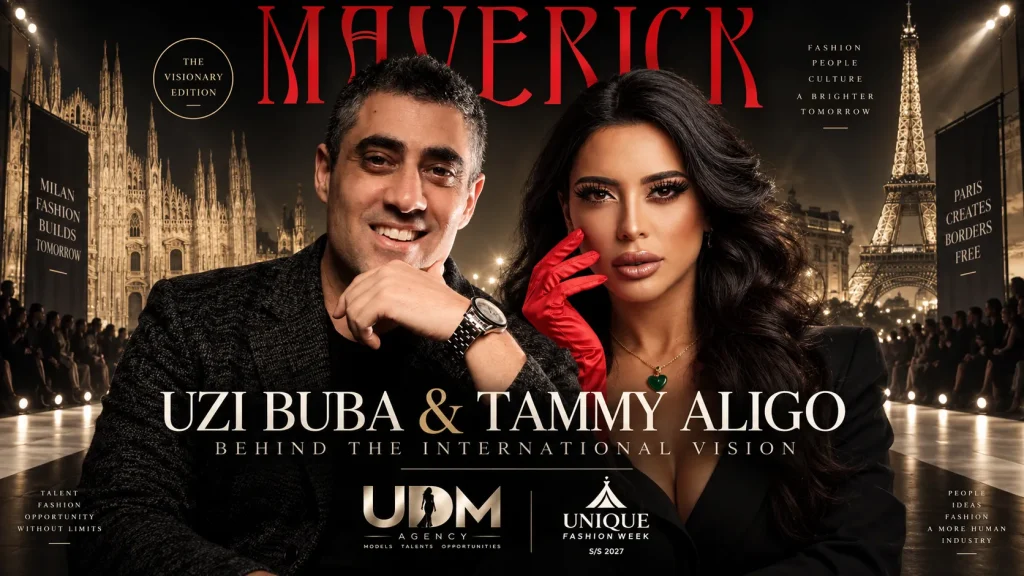
Fashion is full of people who know how to reach the door, or more accurately, how to pay a great deal of money to reach it. Far fewer know how to open it. Fewer still know how to keep it open for the people coming behind them.
That is where Uzi Buba and Tammy Aligo meet. Not at another launch party, not in a chance photo opportunity, and not through a collaboration designed to last only until the flashes die down. The partnership between UDM and UFW London is built around a far more ambitious goal: creating a professional route for Israeli talent and designers into the casting rooms, fittings, productions and runways of fashion weeks around the world.
For Buba and Aligo, genuine Israeli representation is not an Instagram story in front of the Eiffel Tower. It is a name on the casting list, an official credit, a designer given a platform, a model invited back for another season, and a professional relationship that remains alive after the dress has returned to the rack.
They do not want Israel to attend fashion week simply to watch.
They want Israel to come to work.
Uzi Buba and the Discipline Behind the Talent
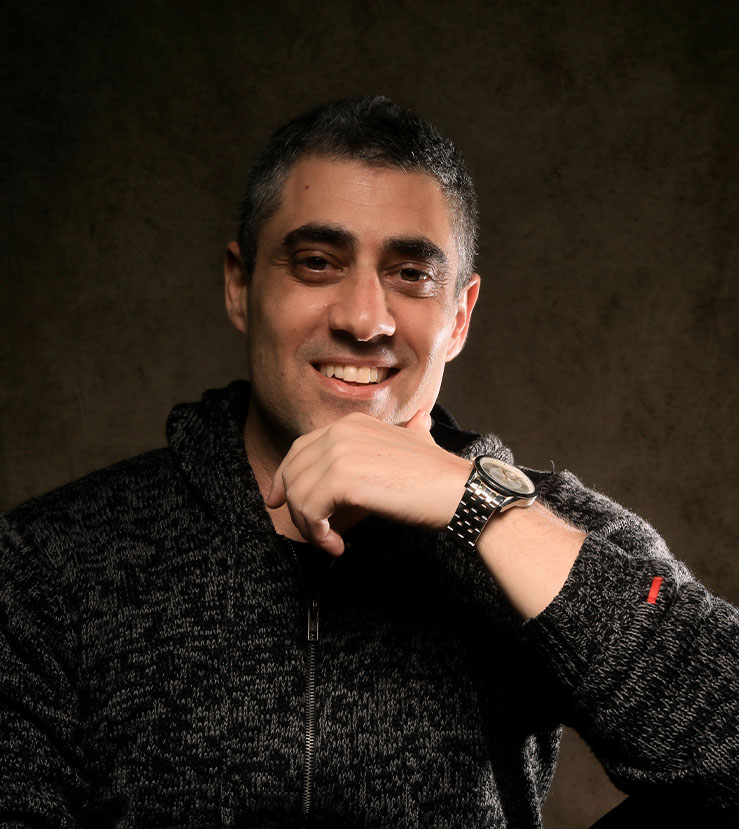
Uzi Buba, a husband and father of three, lives and breathes the fashion industry. He brings extensive experience working with companies and brands in Israel and abroad, as well as a strong background in marketing and business development. That combination gives him a strategic advantage: he understands exactly what clients are looking for on the commercial side, and he knows how to translate those needs into a focused career plan for each talent.
His decision to establish a full-service talent agency did not come from market knowledge alone.
It also came from anger.
Through productions, auditions and direct work with talent, Buba says he witnessed exploitation, a lack of transparency, crossed boundaries and situations in which young people did not receive the protection they needed. UDM’s website recounts difficult experiences that led him to walk away from productions and, eventually, to establish an agency that would see a model as more than a ‘clothes hanger.’
That phrase explains almost the entire brand.
Buba does not pretend that fashion is a gentle world. He knows it is competitive, demanding and fast, a business in which decisions are made in seconds and the word ‘no’ is heard far more often than ‘yes.’ But to him, there is a clear difference between professional standards and humiliation, between discipline and exploitation, and between managing a career and treating a person as a disposable product.
That is why UDM was not built simply to send photographs to clients. It was built around a complete professional framework, centered on a training process that the agency describes as unique in Israel. The goal is to build total professional readiness from the ground up: posing, confidence, presenting a garment properly, body expression, working with light and runway technique. In short, everything a model needs in order to arrive on set ready to perform at the highest level.
That support continues in the field, with close and consistent guidance throughout each model’s journey. A central figure in this system is Zahavit Buba, an integral part of UDM’s core team. Alongside Uzi, she provides personal guidance, direction, an on-set presence and ongoing communication with the models and their families. It is a critical layer of support that provides both reassurance and a genuine sense of security.
Uzi and Zahavit do not promise anyone a way around the hard road.
They want to make sure that no one who steps onto it ever has to walk it alone.
Before Milan There Was Ashdod
If Uzi Buba’s story began behind a computer screen, Tammy Aligo’s began in motion.
Aligo was born in Israel and raised in Ashdod in a Jewish family with deep Georgian roots. Her mother is from Kutaisi and her father from Poti, on the Black Sea. Georgian was spoken at home, and she grew up surrounded by the music, dance and traditions of the Caucasus. As a child, she performed with the Georgian national ballet. In other words, the runway did not teach her how to move. It simply gave her a different kind of stage.
Then came the kind of moment any fashion screenwriter would have loved to invent.
During a stay in Milan, Aligo was discovered on the street. A photographer spontaneously invited her to join a shoot, and that chance encounter became the starting point of her modeling career. She went on to work internationally and appeared on runways in Paris, Milan, Cannes and Tbilisi. According to a profile published by the German newspaper Jüdische Allgemeine, she also worked with names including Michael Lombard, Michael Cinco and Victoria Beckham.
Celebrity pages also remembered Aligo for her widely reported friendship with Gerard Butler, but her professional story is more compelling. She did not remain a name that appeared beside a star. She became someone capable of leading others into the industry.
Her identity is not a minor biographical detail. Ashdod, Israel and Georgia all shape the way she speaks about an international career. The goal is not to erase where you come from in order to fit into the world, but to carry it with you onto the runway.
The Moment a Model Stops Waiting to Be Chosen
The real shift in Aligo’s career did not happen when another designer chose her for a show.
It happened when she began choosing others.
In an interview with Israel Hayom, Aligo described how she became a mentor of sorts to a young model at the beginning of her career. She explained how the industry works abroad, brought her into backstage work and introduced her to designers with whom she had already worked, including Michael Lombard. In the same interview, Aligo was careful to distinguish among a fitting in a store, an event, an official runway show and paid professional work. It may sound like a technical distinction, but in a world where every polished photograph can be labeled an ‘international career’ within minutes, it is worth its weight in gold.
The story of designer Raz Jerufi demonstrates that influence even more clearly.
Aligo was familiar with a memorial dress Jerufi had designed. She remembered it while preparing for activity in Paris and suggested to the production company that the designer be promoted as one of its emerging brands. From there, the collection found its way to the runway, with Aligo herself opening the show in the dress. It was more than a gracious gesture between a model and a designer. It was a live demonstration of what the right connection can do for local talent.
This is also where Aligo outgrows the narrow definition of ‘model.’ She becomes a producer, a mentor and a connector of people, clothes and opportunities.
Tammy Aligo no longer simply wears the garment.
She understands who can get it into the room.
A Professional Power Alliance
The connection between Uzi Buba and Tammy Aligo is compelling precisely because it is not built on appearances.
Buba brings the agency infrastructure: scouting, screening, representation, training, portfolio development, talent management and long-term guidance.
Aligo brings experience from both sides of the runway: the body being measured, the model being assessed, the woman who knows the pace of fashion week, and the professional who has learned who actually makes the decisions backstage.
Buba prepares talent for the moment the door opens.
Aligo knows which doors are worth pursuing.
Buba builds the process.
Aligo brings the relationships and the experience from the field.
Together, they are trying to create a connection that does not end with a flight or a photograph. Their goal is for Israeli talent to arrive better prepared, for Israeli designers to arrive better connected, and for fashion week to become less of a glittering event viewed from the outside and more of a professional space in which they can operate.
This is not a shortcut.
It is a route.
UFW London Is New on Paper Not on the Runway
It is easy to confuse a new branch with a lack of experience.
UFW London may be introducing a new framework to the map, but the experience behind it did not begin yesterday. Aligo brings years of work on runways, in fittings, on productions and throughout international fashion weeks. The partnership with UDM adds Buba’s system for scouting, training and representation.
This is not a start from zero.
It is a new address for experience already earned.
Rather than selling a vague promise of ‘international exposure,’ Buba and Aligo are building the process in the opposite order: first they scout, then they screen, then they prepare, and only then do they take the work abroad.
The glamour comes last. They are emphatic about what comes before it: hard work.
The Numbers Leave No Room for Filters
This is where precision matters.
All of the following figures relating to the audition process refer only to UDM’s temporary representation track. They do not describe UDM’s entire roster, do not include the models already under permanent representation, and do not represent the full scope of Buba and Aligo’s work.
This was a separate program opened to models outside the agency’s existing roster, with the aim of selecting a group for a professional testing period.
More than 700 candidates submitted applications. Only 68 were invited to an in-person meeting and audition. Of those, nine passed the final audition stage and entered a three-month temporary representation period, a testing model commonly used in high fashion.
The broader picture, including UDM’s permanently represented talent, tells a very different story. Twenty-four UDM models are traveling to Paris and nine are traveling to Milan. In total, 31 models are going out to work, with some appearing in both destinations. These figures are not accidental. They reflect the strength of UDM’s training process and close professional guidance, a system designed to take raw potential, build it from the ground up and turn it into a working career that is difficult to ignore.
During the temporary representation period, the agency evaluates far more than appearance and runway technique. Punctuality, the ability to follow direction, discipline, communication with professional teams and performance under pressure all matter. Only after the testing period can the agency determine whether permanent representation is the right next step.
The message is not, ‘You were accepted, so you have made it.’
It is, ‘You have been given the opportunity to prove that you can sustain a career.’
The program’s own materials make the same distinction. It is intended for candidates who passed the auditions but are not yet permanently represented, and longer-term representation is considered only after their professional conduct has been evaluated in practice.
In modeling, the audition does not always end when you leave the room.
Sometimes life itself is the audition.
They Are Sending Models Into the Machine
From the outside, fashion week looks like dresses, flashes, hotels, dark cars and glasses of champagne.
From the inside, it is a machine.
Fittings change at the last minute. Casting schedules are packed. There are long waits, rehearsals, constant travel, very little sleep, rapid changes of clothes and a great many people who must make decisions in seconds.
That is why the partnership between UDM and UFW London is about far more than selecting attractive faces.
Preparation includes runway technique, shoots, fittings, backstage conduct, working with industry professionals, preparing model cards and walk videos, and sending materials to designers in advance. The objective is not to land in a foreign city and only then start searching for opportunities. The professional work begins before departure.
A passport is not a career.
A plane ticket is not a career.
A photograph in front of the Eiffel Tower is not a career either.
A career begins when a name appears on a casting list, when a casting director remembers a face, when a designer asks to see the same talent again, and when the relationship remains active after the story disappears.
More Than Israeli Faces in Foreign Clothes
At this point, the partnership becomes something larger than a story about an agency and a model.
Buba and Aligo do not want to settle for another Israeli woman walking in Paris in a foreign designer’s clothes, or another Israeli man appearing in a backstage photograph in Milan.
The goal is a complete Israeli presence.
Models, but designers too.
Israeli brands, Israeli collections, Israeli stories, local creativity and industry professionals who can meet buyers, producers and casting directors in the international arena.
There is little value in celebrating an Israeli body on the runway if Israeli fashion itself remains outside the door.
Seen in that light, the story of Raz Jerufi is not a side note. It is a small-scale version of the entire vision: one Israeli talent uses her experience and relationships to carry another Israeli creation through the door. That is how a presence is built without depending on one person or one fleeting moment.
Not a delegation that arrives for photographs.
A team that arrives to work.
Israeli Chutzpah at 1.60 Metres and Above
After all of that comes one more initiative.
It is not the central story of the partnership, nor the sole reason behind it. It is another door Buba and Aligo want to open.
They are not satisfied with creating an Israeli presence. They also want to add a little Israeli chutzpah, this time at 1.60 metres and above.
Fashion has already shown that stars below the industry’s traditional height threshold can command a runway, a campaign and a fashion house. Lily-Rose Depp, at approximately 1.60 metres, made her runway debut for Chanel. Aliana King, at approximately 1.63 metres, walked at New York Fashion Week and appeared in campaigns for Fenty Beauty. Devon Aoki, at approximately 1.65 metres, walked for Chanel, Moschino and Versace and became one of the models most closely associated with breaking fashion’s height standard.
Yet these women are still often presented as exceptional proof that it can be done.
Buba and Aligo want that possibility to become less exceptional and more accessible to Israeli talent as well.
They are not promising that every model who stands 1.60 metres tall will be walking in Paris tomorrow. Not every tall model is suited to the runway either. Their aim is for height to be treated as one professional consideration among many, rather than an automatic delete button pressed before anyone has seen the walk, the face, the personality or the way the talent carries a garment.
The 1.60+ initiative does not seek to erase a designer’s needs, the proportions of a collection or the requirements of a production.
It seeks to widen access to the room.
Height is a number.
Presence is power.
And fashion, of all industries, should know how to recognize the difference.